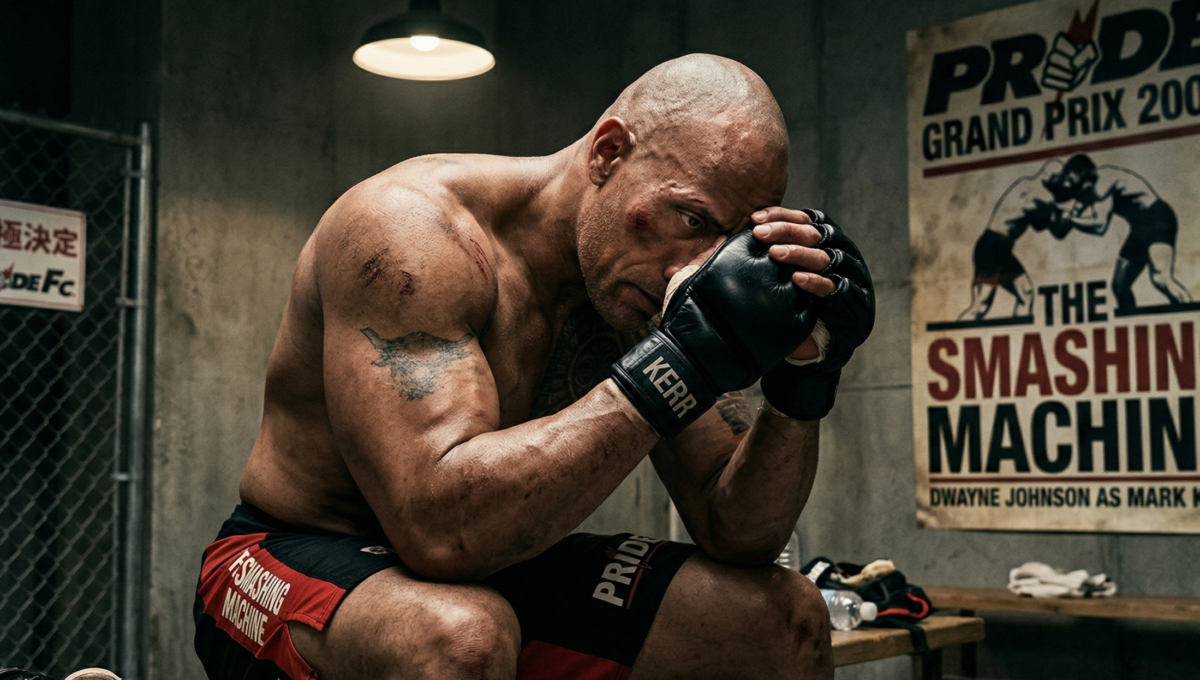
The audience’s lukewarm reception to Benny Safdie’s “The Smashing Machine,” as discussed in “FMC 238 : The Smashing Machine Directed by Benny Safdie,” presents a compelling paradox against the film’s critical praise and an Academy Award nomination for Best Achievement in Makeup and Hairstyling. This stark divergence highlights a fundamental tension between conventional star vehicles and a directorial vision intent on gritty, unflinching realism. Dwayne Johnson’s radical physical transformation, achieved through meticulous prosthetics and a striking hairpiece, served not only as a testament to the film’s commitment to verisimilitude but also inadvertently became a focal point that perhaps overshadowed the nuanced narrative for a broader public accustomed to the actor’s more familiar persona.
The Embodiment of Trauma: Performance and Prosthesis
Dwayne Johnson’s performance as Mark Kerr, the titular “Smashing Machine,” marks a significant departure from his established star image, venturing into a realm of raw, dramatic acting that garnered widespread critical approval. The podcast highlights how this transformation, particularly the use of prosthetics for his nose and the alteration of his hairstyle, was the initial “buzz” surrounding the film. This is not merely cosmetic; it is a profound act of embodiment, forcing both actor and audience to confront a persona stripped of its larger-than-life polish. Johnson’s physical alteration, described as making him “look so different,” becomes a crucial element of the film’s craft, enabling a portrayal that feels authentically grounded in Kerr’s struggle, rather than merely a celebrity playing a role.
Safdie’s direction leverages this transformation to underscore the film’s “artistic, documentary style.” The camera often lingers on Johnson’s altered face, allowing the audience to witness the physical toll of Kerr’s profession and personal battles. This close engagement with the actor’s embodiment, facilitated by exceptional makeup and hairstyling — as evidenced by the Academy Award nomination — aligns with the film’s ambition to present a “sad story” with unvarnished honesty. Unlike the triumphant narratives often associated with boxing or MMA films (e.g., “Rocky”), “The Smashing Machine” embraces a more tragic arc, focusing on the human cost of ambition and addiction. Johnson’s ability to convey this inner turmoil, often through subtle shifts in his expression beneath the prosthetics, suggests a performance of considerable depth, moving beyond the expectations of a typical “Rock” action film.
The Economics of Authenticity: Budget, Genre, and Audience
The significant financial disparity between “The Smashing Machine’s” $40 million budget and its $21 million worldwide gross, deemed a “big L” for a film starring Dwayne Johnson, raises questions about the commercial viability of blending high-budget star power with an “artistic, documentary style.” The podcast hosts drew a direct comparison to Darren Aronofsky’s “The Wrestler,” a film with a similar thematic core (the struggles of a aging fighter) but a vastly different budget ($6 million grossing $45 million). This comparison is instructive: while both films aim for realism and character depth, “The Smashing Machine’s” larger financial outlay, particularly for a narrative described by critics as “somewhat flat or repetitive,” suggests a miscalculation of its market.
Safdie’s commitment to authenticity, admirable from a craft perspective, contributed directly to this budget. The podcast explicitly mentions filming in diverse locations, including Japan, and the extensive undertaking of building a “full house set” to accurately depict Kerr’s environment. These choices, while enhancing the film’s verisimilitude and allowing for a nuanced depiction of the fighter’s world, are inherently costly. For a film that ultimately resonated more as a “film festival darling” than a “pop” hit, such substantial investment in production design and location shoots for a niche story proved financially unsustainable. The tension here lies in the commercial pressures on a major star vehicle conflicting with an artistic pursuit of gritty, often uncomfortable realism. While Johnson’s transformative performance was lauded, the film’s refusal to conform to a more conventional, audience-pleasing narrative, coupled with its high production values, created a significant chasm between critical appreciation and box office success.
Further Viewing & Reading
- **The Wrestler (2008) directed by Darren Aronofsky:** A quintessential film about the brutal realities of professional fighting and aging, offering a powerful comparison point for “The Smashing Machine” in terms of tone and theme.
- **Uncut Gems (2019) directed by Benny and Josh Safdie:** Another Safdie brothers film, demonstrating their distinct style of intense, character-driven narrative and relentless pacing, which informs Benny Safdie’s solo directorial work.
- **Michael Clayton (2007) directed by Tony Gilroy:** Features another stellar transformative performance by an actor known for other roles (George Clooney), diving into the moral ambiguities of professional life.
- **Foxcatcher (2014) directed by Bennett Miller:** Explores the darker side of athletic ambition and mentorship, with a focus on character psychology and a tone that resonates with the “sad story” aspect of “The Smashing Machine.”