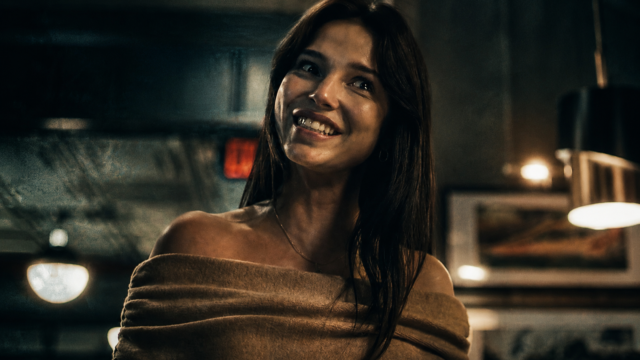
It demands a director of specific intent to plumb the depths of human darkness without succumbing to sensationalism or sentimentality. Patty Jenkins, with her 2003 debut feature Monster, achieves precisely this, delivering a film that forces audiences to confront the origins of monstrous acts rather than simply recoiling from them. The recent Filmmaker Commentary episode, FMC 019: Monster Directed and Written by Patty Jenkins, explores the intricate directorial and performance choices that imbue this harrowing true story with such profound, unsettling empathy. This is not a work that asks for forgiveness, but for understanding—an intellectual and emotional challenge met with unflinching resolve.
The Visual Narrative of Trauma
Jenkins immediately establishes her film’s challenging premise through a masterful opening sequence. The podcast highlights the director’s deliberate choice to front-load a visual history of Aileen Wuornos. We see a young, innocent Aileen, presented through a grainy, almost 8mm-style lens, slowly stripped of her childhood and dignity. This montaged journey culminates with the present-day Aileen under a desolate bridge. Rain washes over her worn, hardened face. Then the stark title card, “Monster,” appears. This is visual storytelling at its most potent; it bypasses exposition and plunges the viewer into context. As discussed, the initial studio preference was to open directly with the older Aileen under the bridge, forcing a more immediate, shocking introduction. Jenkins fought for the montage, understanding its necessity. This early struggle for creative control underlines her “aggressive director” sensibility. She comprehended that providing even a sliver of origin, of a life lived and brutally shaped, was crucial. This prologue does not demand sympathy; it simply informs. The audience arrives at that first shot of the protagonist with foundational awareness: this is a real person, not merely a caricature of evil. The visual language quickly establishes that Jenkins prioritizes depth over superficial judgment, a critical tightrope walk she navigates with remarkable skill.
Crafting Authenticity: Performance, Casting, and the ‘Indie’ Aesthetic
The film’s commitment to raw authenticity extends deep into its casting and aesthetic choices. Charlize Theron’s physical transformation into Aileen Wuornos remains legendary, rightfully earning her an Academy Award. The podcast emphasizes how complete this metamorphosis was; not just the makeup, but how Theron inhabited the character to the point that people on set, familiar with the real Charlize, visibly reacted differently to her in character. Jenkins made a pointed casting decision with Christina Ricci as Selby, Aileen’s girlfriend. Rather than casting an actress who physically resembled the real Selby, Jenkins chose Ricci to embody how Aileen perceived Selby: as innocent, childlike, and attractive. This subtle but profound choice allows the audience to experience Selby through Aileen’s subjective, longing gaze, deepening the audience’s connection to Aileen’s emotional world. Jenkins even admitted this casting had a “trick” element, leveraging Ricci’s established appeal to draw viewers into the film’s unexpected romantic core.
Monster was shot in a mere 28 days on an $8 million budget. This financial constraint, while challenging, inadvertently contributed to the film’s gritty, unpolished aesthetic. The film does not feel “highly stylized”; it embraces a rough-hewn, almost “Indie” quality that foregrounds performance over elaborate visual flair. The lighting, for example, prioritizes practicality and mood over pristine perfection. This contributes to a sense of lived-in reality rather than a glossy reconstruction. This commitment to performance above all else is evident in scenes where technical aspects had to take a back seat. Continuity issues, like rain on one side of a car but not the other, were simply “rolled with.” This decision reflects the urgency and focus on capturing raw emotion rather than pristine technical exactitude. Jenkins understood that the story’s power lay in its human core, not in cinematic ornamentation. She leveraged every aspect of production to serve that truth.
Critical Insight
Monster offers a profound commentary on the societal construction of identity, particularly for marginalized individuals. Jenkins masterfully subverts the expectation of a one-dimensional villain by presenting Aileen Wuornos as a composite of brutalized humanity. The film refuses to shy away from Aileen’s horrific actions. Yet it simultaneously forces the audience to acknowledge the systemic abuses and profound emotional deprivation that shaped her. This isn’t an act of absolution. Instead, it is a compelling exploration of how repeated trauma and societal rejection can warp a soul to the point of self-justified violence. Jenkins doesn’t simply tell Aileen’s story; she peels back the layers of a life defined by relentless struggle. She exposes the fleeting moments of tenderness and yearning for connection that flicker beneath the hardened exterior. The genius of Monster lies in its insistence that even the “monster” is a product of a complex personal history. This challenges our comfortable binary definitions of good and evil. It pushes us to understand the roots of desperation, rather than merely condemning its fruit. This is the intellectual payoff, forcing us to grapple with uncomfortable truths about human capacity for both cruelty and fleeting vulnerability.
Key Takeaways
- Visual storytelling trumps exposition: Jenkins’ opening montage establishes Aileen’s traumatic past non-verbally, providing essential context without lengthy dialogue or explanation.
- Director’s conviction: Jenkins fought for critical scenes and artistic choices, demonstrating clear vision and an assertive directorial style.
- Performance-driven casting: Casting decisions, like Christina Ricci as Selby, reflected the protagonist’s subjective reality, enhancing emotional depth.
- Budget shapes aesthetic: Financial constraints contributed to the film’s raw, indie feel, prioritizing authentic performance over stylization.
- Embrace the unexpected: The film’s musical choices (e.g., Steve Perry) and continuity imperfections were leveraged or accepted, showcasing filmmaking adaptability.
- Humanity in the monstrous: The film portrays its subject as a complex, multi-faceted individual, challenging simplistic villainy and demanding empathetic understanding of trauma.
Questions Worth Asking
- How did Patty Jenkins’ extended hiatus from feature filmmaking after Monster, despite its critical success, reflect broader industry biases or structural issues regarding female directors, and how has that landscape since changed?
- Considering the film’s unflinching portrayal of violence and Aileen’s eventual shift from self-defense to serial murder, at what point, if any, can an act of killing be truly “justified” within the narrative, and how does the film navigate this moral ambiguity?
- How might Jenkins’ later experience directing large-scale action in Wonder Woman have been influenced by the practical challenges and aesthetic decisions made on a low-budget, performance-heavy film like Monster?
Further Viewing & Reading
Wonder Woman* (2017): Directed by Patty Jenkins. Offers a fascinating contrast in scale and genre, showcasing Jenkins’ evolution while maintaining a focus on strong female protagonists and human emotional cores.
Capote* (2005): Directed by Bennett Miller. Another film dealing with a real-life murderer and the journalist who investigates them, offering a different lens on the complexities of such narratives.
Lady Bird* (2017): Directed by Greta Gerwig. Provides a comparative study of female directors tackling intense emotional performances, offering insights into differing directorial approaches discussed in the podcast.
Monster* (Book by Aileen Wuornos and Susan Kendall): For those interested in the real-life accounts that inspired the film, offering a deeper dive into the factual basis and Aileen’s own perspective.